Hey everyone, it’s Jake from your go-to Camlock coupling supplier, and today I’m breaking down one of the most common questions I get from both new guys just starting out and seasoned operators who’ve been around the block: What’s the actual cost of a Camlock coupling? I know it’s not just a straight number—there’s way more that goes into the price tag than just the part itself, and if you’re shopping around right now, you’ve probably noticed those prices swing way more than you’d expect for a seemingly simple piece of hardware. Let’s cut through the noise and get real about what you’re paying for, no sales fluff, just straight talk from someone who’s been in the game for 10+ years. Camlock Coupling
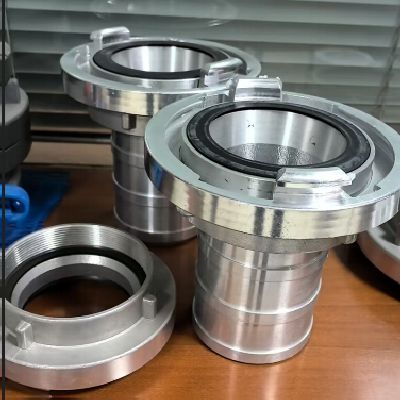
First off, let’s get one thing straight: Camlock couplings aren’t all the same. I see people browsing Amazon or a random industrial site and seeing a $5 brass coupling that fits their line, then panicking when our price is double that. But here’s the secret most of those sites don’t tell you—those cheap couplings are often made with scrap metal, have loose tolerances that’ll leak on you mid-job, and might not even meet industry standards. I’ve had customers come to me after a $100 batch of cheap couplings died on them during a peak harvest or a chemical transfer, costing them thousands in downtime and mess. So when I talk about cost, I’m not just talking about the upfront sticker price—this is total cost of ownership (TCO), which is way more important for anyone who relies on these parts to keep their operations running.
Let’s start with the upfront, base cost because that’s what everyone sees first. The base price of a Camlock coupling depends on three big factors: material, size, and style. Let’s break each down so you know exactly what you’re paying for.
First, material. This is the biggest driver of upfront cost, hands down. The most common materials are brass, aluminum, stainless steel, and polypropylene (plastic). Let’s do a quick run-through: brass is the go-to for general use—think water, mild chemicals, agricultural fluids, stuff like that. It’s durable, easy to machine, and doesn’t break the bank. Right now, a 2-inch brass cam and groove coupling (one of the most common sizes) is going for roughly $15 to $25 each, depending on the brand and quantity. Then there’s aluminum, which is half the weight of brass, perfect for applications where you’re handling heavy hoses and don’t want to add extra weight—like construction, bulk hauling, or plumbing for large commercial buildings. Aluminum is cheaper than brass, usually $10 to $18 for that same 2-inch size. But wait, aluminum has a catch: it’s not great for saltwater or harsh chemicals, and it can corrode over time if you’re using it in high-moisture, high-salt environments. That’s why a lot of guys in marine industries swear by stainless steel. Stainless is way more corrosion-resistant, can handle way harsher chemicals, and is even food-grade if you’re working with edible products like beer, soda, or farm produce. The downside? It’s pricey—same 2-inch size is $30 to $50, depending on the grade (304 vs 316 is a big difference; 316 is more resistant to salt, so it’s a bit higher). Then there’s polypropylene, the plastic option. It’s lightweight, super resistant to most acids and bases, and cheap—like $5 to $12 for that same 2-inch. But it’s not for high pressure or high temps; if you’re pushing more than 150 PSI or dealing with temps over 180°F, it’ll crack or melt. So material is all about matching the coupling to your specific job, not just picking the cheapest one.
Next up is size. Camlock couplings come in sizes from ½ inch up to 12 inches, and the price jumps a lot as size goes up. That 2-inch brass one I mentioned earlier? $15 to $25. A 4-inch brass? That’s $40 to $60. A 6-inch? $70 to $100. Why? Because you’re using way more material—obviously, a bigger part needs more metal, but also the machining gets more complex. Larger couplings have to handle higher volume and pressure, so the mold and tooling is more expensive. The good news is that when you’re buying in bulk, the per-part price drops. If you need 100 of those 2-inch brass ones, it’s $12 to $20 each, not $15 to $25. Buy 500, and it’s even lower—like $10 to $18. So quantity is another big upfront factor, and if you’re buying for a whole operation, bulk is almost always the way to go.
Then there’s style. Camlock couplings come in Type A (male adapter for hose), Type B (female coupler for hose), Type C (female coupler for pipe), Type D (male adapter for pipe), Type E (plug for cleaning or draining), Type F (female coupler for tank truck), and Type DC (dust cap). Some styles are more specialized, like the Type F which is made specifically for bulk tank connections, so they have extra seals that make them more expensive. A Type F brass 2-inch is $20 to $30, versus $15 to $25 for a Type A. So style matters too—don’t pay for a special part if you just need a basic hose adapter.
But here’s where a lot of people mess up: they stop at the upfront cost, and don’t account for the hidden costs that come with cheap, low-quality couplings. Let’s talk about those, because this is where the real money gets lost. I’ve had a construction customer come to me last year who bought 50 aluminum couplings from a random supplier for $8 each (that’s $2 less per part than our price). He was hauling diesel fuel for his trucks, and within three weeks, 12 of those couplings corroded on the cam arms, so they wouldn’t lock, leading to three spills. Each spill cost him a $1,200 EPA fine, plus $500 in cleanup, plus 8 hours of downtime where his trucks couldn’t run— that’s $1,700 per incident, times three, plus the cost to replace the bad couplings. He ended up spending way more than if he’d bought our higher-quality aluminum ones for $10 each. That’s the hidden cost of cutting corners: downtime, fines, cleanup, lost product, and even safety risks if a coupling fails mid-job with a hazardous chemical.
Another hidden cost is replacement. Cheap couplings wear out faster. I’ve seen a set of cheap poly couplings last 6 months in a fertilizer mixing job, while a food-grade poly (higher quality, better resin) will last 2-3 years. So you’re buying new parts twice as often, which adds up over time. And if you’re dealing with food or pharmaceuticals, cheap couplings might have residual chemicals that leach into your product, leading to recalls or lost batch runs— that’s a whole other level of cost most people don’t see coming.
Now, let’s talk about factors that affect pricing from a supplier’s side, because if you’re wondering why my price is higher than Amazon, it’s not just profit—there are real costs we have to cover. First, raw material costs. Brass, aluminum, and stainless are commodities, right? So when the price of copper (which makes up most of brass) or aluminum spikes, we have to pass that on. Last year, copper prices went up 20% in 6 months, so we had to adjust our prices a little to keep up, but we never raised them as much as those no-name suppliers, who often use lower-quality scrap metal when commodity prices are high to cut costs. Then there’s quality control. Every coupling we ship gets tested for leak tightness, tolerance, and material grade. We don’t send out parts that have burrs that can cut hoses, or seals that will dry out in 6 months. That adds time and labor cost, but it means you get a part that works when you need it. Then there’s customer support. If you have a question about which coupling you need for your application, we’ll help you figure it out—no charge, no pressure to buy more. If you have a problem with a part you got from us, we’ll replace it fast, no questions asked. Those things cost money, but they’re worth it for our customers.
Wait, and what about custom or specialty Camlock couplings? A lot of guys need something that’s not off-the-shelf—like a coupling with a specific seal for a unique chemical, or a size that’s not standard, or a coating for extreme temps. Those will be more expensive, obviously—custom tooling and specialized materials add cost, but they’re necessary if you’re working with something out of the ordinary. For example, if you need a stainless steel coupling with a Viton seal (which is resistant to harsh chemicals), that’s going to be more than a standard EPDM seal, because Viton is a more expensive rubber, and the machining has to be precise to fit it.
Let’s do a quick real-world example to make this concrete. Say you’re a small farm handling water and mild fertilizer, and you need 20 2-inch couplings for your irrigation system. If you go for the cheap aluminum ones, that’s $10 total upfront. But if those wear out in a year, you’ll spend $10 again next year, plus if one leaks and floods a small part of your field, that’s lost crops—say $500 worth. If you buy our high-quality aluminum couplings for $20 total, they’ll last 3-4 years, so over 4 years, that’s $20 total, no leaks, no lost crops, no downtime. That’s a no-brainer, right?
Another example: a small construction company that hauls water for concrete mixes. They need 10 3-inch couplings, aluminum. Cheap ones: $8 each = $80 upfront, last 6 months. So over 2 years, that’s $320, plus if a coupling fails mid-pour, that’s the whole batch of concrete going to waste—$1,000+ per pour, plus downtime. Our high-quality aluminum: $12 each = $120 upfront, lasts 2+ years, no leaks, no wasted concrete. Again, way cheaper long-term.
Now, let’s address the elephant in the room: are there times when cheap couplings are okay? Yeah, sometimes. If you’re using poly couplings for non-critical, low-pressure water transfer where downtime isn’t a big deal, and you’re only going to use them a few times, then cheap is fine. But if this is a part you’re going to use every day, rely on, and can’t afford to fail, you need to go with quality. That’s the line I always draw: what’s the impact if this coupling breaks? If it’s a minor hassle, cheap works. If it’s lost product, downtime, fines, or safety risks, pay for the good stuff.
So, to wrap this up, the cost of a Camlock coupling isn’t a single number—it’s a balance between upfront cost and total cost of ownership. The upfront price is driven by material, size, style, and quantity, but the hidden costs of low-quality parts can far outweigh the savings of buying cheap. As a supplier, I know you have a budget, and I’m not here to sell you the most expensive part just because. I’m here to help you pick the right part for your job, at a fair price, so you don’t end up paying for mistakes down the line.
If you’re not sure what kind of Camlock coupling you need, or you want a quote for bulk orders, hit us up. We don’t do pushy sales calls, we don’t hide our prices, and we’ll answer every question you have. Whether you need 10 couplings for a small project or 1,000 for a whole operation, we’ve got you covered at a price that won’t break the bank, and quality that you can count on to keep your jobs running smoothly.
Hose Mender References
- Industrial Pump Manufacturers Association. (2022). Cam and Groove Coupling Selection Guide.
- National Institute for Occupational Safety and Health (NIOSH). (2021). Costs of Equipment Failure in Agricultural and Construction Industries.
- Material Properties Council. (2023). Commodity Metal Price Trends and Their Impact on Industrial Component Pricing.
Suzhou Fuyikang Metal Industrial Co., Ltd.
As one of the most professional camlock coupling manufacturers and suppliers in China, we have world-leading production equipment and strong manufacturing capabilities. We warmly welcome you to buy bulk high quality camlock coupling for sale here from our factory.
Address: No.26.Mudong Rd,Mudu Town, Wuzhong Distric, Suzhou City,Jiangsu Province,China
E-mail: SZFYK@SZFUYIKANG-COUPLING.COM
WebSite: https://www.fyk-coupling.com/
